AI Automations
Voice AI ReceptionistCustom AI AssistantsLead Nurturing & SMS Text-BackReview AutomationAI Appointment SchedulingNo-Show Recovery AutomationClient Case Studies
Turf Titans Local SEO PlaybookTurf TitansChicago After-Hours: How Missed-Call Text-Back Books Jobs

Published July 4, 2026
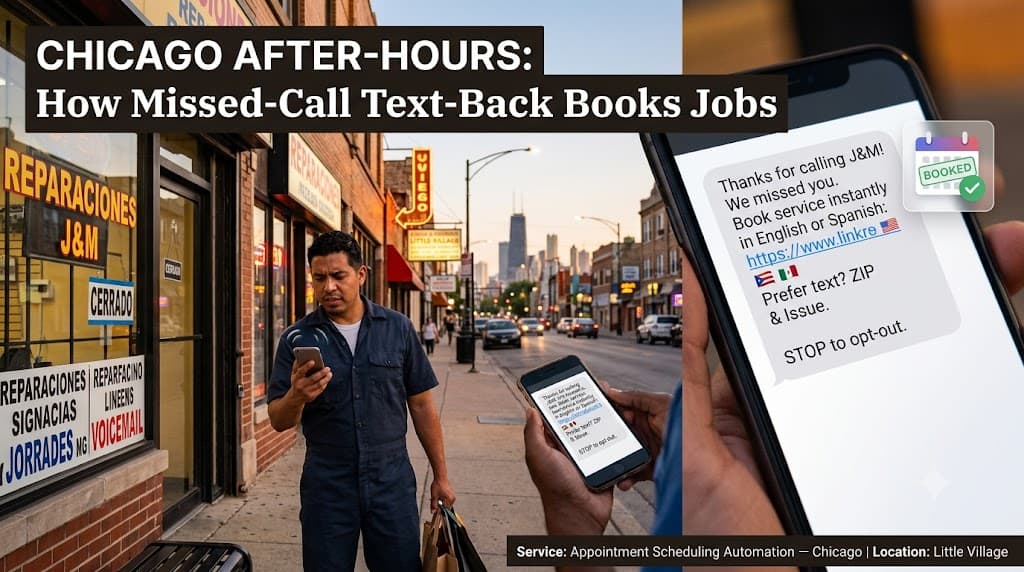
Voicemail isn’t neutral—sending callers there after 5 pm quietly leaks your best leads, while a simple auto-text often wins them back. For Chicago service businesses, that gap is the difference between finishing the week with empty slots or a full route. The fix is straightforward: replace voicemail with a bilingual missed call text back that links directly to online booking.
If you serve neighborhoods like Little Village, Albany Park, Pilsen, or Portage Park, your callers are juggling shifts, childcare, and commutes. They call when you’re closed. If your line rings out, they try the next company. A missed call text back meets them where they are—on their phone—while they’re still motivated.
Bottom line up front: set your phones to trigger a bilingual missed call text back within 10–20 seconds, include a one-tap booking link, and keep the conversation going by SMS so after-hours calls become next-morning appointments. If you want a done-for-you setup, see our Chicago-specific playbook in Appointment Scheduling Automation.
What is a missed call text back and how does it work?
A missed call text back is an automatic SMS sent when you can’t answer. Instead of voicemail, the caller gets a helpful message that acknowledges the call, offers the most common next step, and includes a direct booking link.
Under the hood, your phone system or call-tracking number posts a “missed call” event to your messaging platform. The platform looks up the caller, chooses the right language, inserts your booking link, and sends the text—ideally within 10–20 seconds while the phone is still in their hand.
A strong setup adds guardrails:
- •Quiet hours so late-night calls queue a morning text instead of pinging someone at 11 pm.
- •Built‑in opt‑out language (“Reply STOP to opt out”) in every first message.
- •Link tracking so you know who clicked and booked.
- •Routing rules by neighborhood or ZIP so North Side vs. Southwest Side teams get the right appointments.
When do Chicago callers try to book after business hours?
Patterns vary by trade, but across Chicago we consistently see three after-hours surges:
- •Weekday early evenings, roughly 6:30–8:30 pm, once kids are settled and traffic dies down.
- •Saturday morning windows, 7:30–10:30 am, when people tackle home tasks before soccer or errands.
- •Shoulder seasons (spring and fall) when daylight shifts and homeowners notice issues after work.
Layer in neighborhood rhythms. In Little Village and Pilsen, many residents work hospitality or trades with later shifts; a 7:45 pm text gets more clicks than a 5:15 pm one. On school nights, a 7:00–7:30 pm window catches decision-makers after dinner. In winter, earlier sunsets push calls earlier—your text-back still wins because no one wants to sit through voicemail while wearing gloves at a bus stop.
Use these realities to adjust your timing rules:
- •Send immediately until 8:45 pm.
- •From 8:46 pm–7:59 am, queue the message to fire at 8:00 am with a “Good morning” opener.
- •On Saturdays, allow texts a bit earlier (from 8:00 am) since weekend to‑do lists start fast.
What should the first text say to earn a fast reply?
Keep it short, helpful, and action‑oriented. The first message should:
- •Acknowledge the missed call.
- •Offer the easiest next step.
- •Provide a one‑tap booking link.
- •Include opt‑out language.
Example for Chicago service pros (English):
- •“Thanks for calling [Business Name]. We just missed you. Need help with [service]? Book in 20 seconds here: [booking link]. Prefer to text? Reply with your ZIP and issue. Reply STOP to opt out.”
Spanish for Little Village (formal tone):
- •“Gracias por llamar a [Business Name]. Lamentamos no haberle contestado. ¿Necesita ayuda con [servicio]? Reserve en 20 segundos aquí: [enlace]. Si prefiere, responda con su código postal y el problema. Responda ALTO para dejar de recibir mensajes.”
Two tweaks lift reply rates:
- •Add a quick “either/or” prompt if they don’t click: “Want me to book for you? Reply 1 for morning, 2 for afternoon.” In Spanish: “¿Quiere que lo agendemos? Responda 1 para la mañana, 2 para la tarde.”
- •Mirror neighborhood language norms (English first in Lakeview; Spanish-first in Little Village) while always offering both.
How do you turn replies into real appointments automatically?
Your text shouldn’t just talk—it should schedule. Build a short decision tree that ends in a confirmed slot, not a promise to “call you back.”
Here’s a proven flow:
- •Missed call triggers the initial bilingual text with the booking link.
- •If no click in 2 minutes, send a gentle nudge with a quick choice: “Want me to hold a spot? 1=Tomorrow AM, 2=Tomorrow PM.”
- •When they answer, the system looks up open slots by service area and tech availability.
- •It books the appointment, sends a confirmation text with date/time, address on file, and a reschedule link.
- •It adds the event to your calendar, tags the source as “After-hours text,” and starts reminders: 24 hours + 2 hours before.
- •If the address is new, request it by SMS with a single prompt: “What’s the service address?” and validate it automatically.
- •For jobs requiring a deposit, send a secure payment link before confirming.
Chicago-specific refinements:
- •Assign by neighborhood to reduce drive time (e.g., South Lawndale techs handle Little Village replies by default).
- •Offer bilingual reminders so households see the details in their preferred language.
- •For older buildings and multi-flats, add an “entry notes” prompt: “Buzzer? Gate code? Floor?” to avoid morning delays.
If this sounds like a lot to wire up, Base64 Marketing builds and maintains bilingual, after-hours text-back and booking flows for Chicago service businesses. See how we handle scheduling automation → Same‑day setup. No contracts. Local support.
Should a missed call text back replace voicemail or work alongside it?
Replace it. Voicemail adds friction, hides data, and loses urgency. A missed call text back captures attention immediately and converts while the lead is still comparing options.
Make voicemail a tiny safety net, not the path. Use a 5–7 second greeting during closed hours that says: “We just texted you a link to book instantly. If you don’t text, we’ll follow up tomorrow.” Then end the call. The SMS carries the interaction, tracks clicks, and books the job. No more inboxes full of transcriptions missing key details.
How can bilingual English and Spanish flows help in Little Village?
In Little Village, Spanish-first communication isn’t a preference—it’s table stakes. A bilingual flow increases trust and speed to booking because it removes the hesitation of “Will they understand me?” and “Do they serve my area?”
Practical moves that pay off:
- •Start Spanish-first for numbers with past Spanish interactions or for neighborhoods like Little Village; always include an English option in the same message.
- •Use respectful “usted” forms and clear service words: “estimación,” “cita,” “horario,” “domicilio.”
- •Provide both a link and a texted path to book, since some callers prefer to answer two quick questions instead of tapping a web form.
- •Mirror tone and punctuation—accents and clarity matter. “¿Prefiere español?” reads as care, not marketing.
Sample two-step Spanish mini-flow:
- •“Vimos su llamada. ¿Prefiere agendar por mensaje o con el enlace? Responda 1=Mensaje, 2=Enlace. ALTO para salir.”
- •If “1”: “Perfecto. ¿Mañana por la mañana o por la tarde?” → “Gracias, su cita es el martes 10 a las 9:30 am en [dirección]. Enlace para reprogramar: [link].”
What KPIs prove your text back is increasing booked jobs?
Measure the before-and-after. The right dashboard shows you if after-hours calls are becoming revenue.
Track these KPIs weekly:
- •Missed-call capture rate: texts sent ÷ missed calls. Aim for 95%+.
- •Link click-through rate: unique clicks ÷ initial texts. Healthy range: 35–60% with a clear CTA.
- •After-hours booking rate: booked appointments ÷ after-hours missed calls. Many Chicago trades land 15–35% once the flow is tuned.
- •Time-to-first-reply: median minutes from text to customer’s first response. Under 3 minutes signals high intent.
- •Opt-out rate: opt-outs ÷ delivered initial texts. Keep it under 2%; if higher, tighten targeting and wording.
- •No-show rate: missed appointments ÷ booked. Automated reminders should push this below 5–7%.
- •Revenue per after-hours booking: total revenue from after-hours bookings ÷ count. Helps justify evening coverage or weekend crews.
Simple improvement example: If you field 120 after-hours missed calls in a month and move from 5% voicemail callbacks to 25% booked via text, that’s 30 added jobs. Even at a modest $250 average ticket, you’ve unlocked $7,500 without staffing the phones at night.
Local takeaway and next step
Chicago callers don’t want voicemail. They want a fast path to “done,” in English or Spanish, right after they dial. Replace voicemail with a bilingual missed call text back that links straight to online booking, and let a short SMS flow handle the rest—address, time window, reminders, and even payment when needed.
Our stance is firm because the results are: every Chicago service business should replace voicemail with a bilingual missed-call text-back that links directly to online booking. If you want a ready-to-run configuration, our Appointment Scheduling Automation — Chicago blueprint is built for neighborhood realities, from Little Village to Lakeview.
Get a free text‑back setup review for your Little Village service area → /locations/chicago/little-village
FAQs
Common questions
What is a missed call text back?▾
An automatic SMS sent to a caller you couldn’t answer, offering help and a direct booking link.
Is missed-call texting legal in Chicago and Illinois?▾
Yes when it’s conversational or transactional, includes opt-out language, and respects quiet hours and consent.
Do I still need voicemail if I use text-back?▾
No. Use a short greeting that points callers to your text. Let SMS handle booking.
Can the text go out in Spanish automatically?▾
Yes. Detect language from caller history or neighborhood patterns and route to a Spanish template by default in Little Village.
What happens if a customer doesn’t click the link?▾
Your flow should ask a quick question and book by text, or schedule a call-back window.
What metrics should I watch?▾
Missed-call conversion, link clicks, bookings, time-to-first-reply, opt-out rate, and no-shows.
How fast should the text send after the missed call?▾
Within 10–20 seconds so the caller still has their phone in hand.
Get Started
Get the audit: we'll show your top 10 ranking + lead leaks.
We'll show your top 10 ranking + lead leaks, and exactly what to fix first.
Or call us: (312) 646-0326