AI Automations
Voice AI ReceptionistCustom AI AssistantsLead Nurturing & SMS Text-BackReview AutomationAI Appointment SchedulingNo-Show Recovery AutomationClient Case Studies
Turf Titans Local SEO PlaybookTurf Titans
From zero to hero: how we grew monthly revenue 2.73x, drove 16x form submissions, and took phone calls from under 10 to 40–60 a month
A real local home-services success story: 173% revenue growth, phone calls up from under 10 to 40–60 a month, and dominant rankings for high-intent keywords like “lawn leveling service,” “yard leveling near me,” and “lawn care Huntsville AL” — all in one growing season.

Founder & Lead Engineer · Published July 4, 2026
Client: Turf Titans Lawncare · Market: Huntsville & Madison, AL · Updated July 2026
$11K → $30K
Monthly revenue
+173% in 90 days
16x
Form submission rate
143 in 4 months vs. old site's pace
40–60
Calls per month
49 attributed in analytics + GBP; client-confirmed floor
69
Clicks on "turf titans"
Up from 0 six months prior
100+
Local keywords ranking
Many now top 5–10
This is a full data breakdown of a local SEO and website campaign for Turf Titans, a lawn care and landscaping company serving Huntsville and Madison, Alabama. Everything below — the Google Search Console tables, the monthly trend chart, the keyword lists — is pulled directly from the account, not rounded up for effect. We’re publishing the full picture, including the queries that are still climbing and not yet converting, because the more useful case study for another business owner is the honest one. By the end of this page you’ll have the exact strategy, the timeline it ran on, the results it produced, and a repeatable framework you can apply to your own local services business — plus a free downloadable checklist and keyword list to get started.
Key takeaways
- A new, schema-rich, mobile-first site plus parallel Google Business Profile work took Turf Titans from ~$11K to ~$30K in monthly revenue in two months
- GBP shows just 15 tracked calls last month, which the client says is too low — they confirm actual volume runs 40–60 calls/month, and describe that as a conservative floor; their daily count (~5/day since April) suggests an estimated ~475 total calls in that window
- 74 distinct search queries went from 0 to real clicks in six months, including 69 branded “turf titans” clicks from a standing start
- Website form submissions have reached 143 to date — first submission arrived just six days after the February 19 launch, a pace roughly 16x the old single-page site's rate, and the count keeps climbing well past the original 90-day milestone
- The strategy is a repeatable, category-agnostic seven-step framework — not a one-off trick
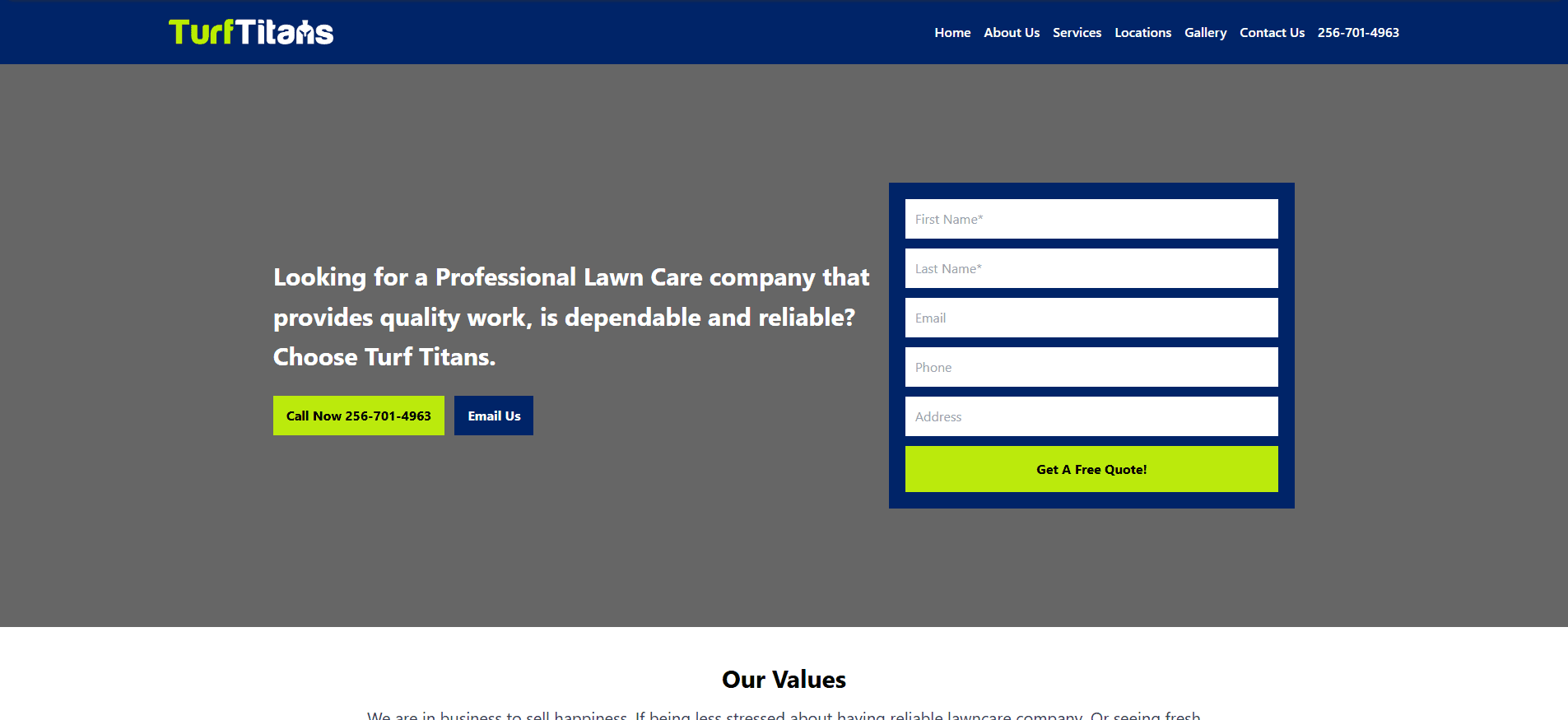
Before — March 2026
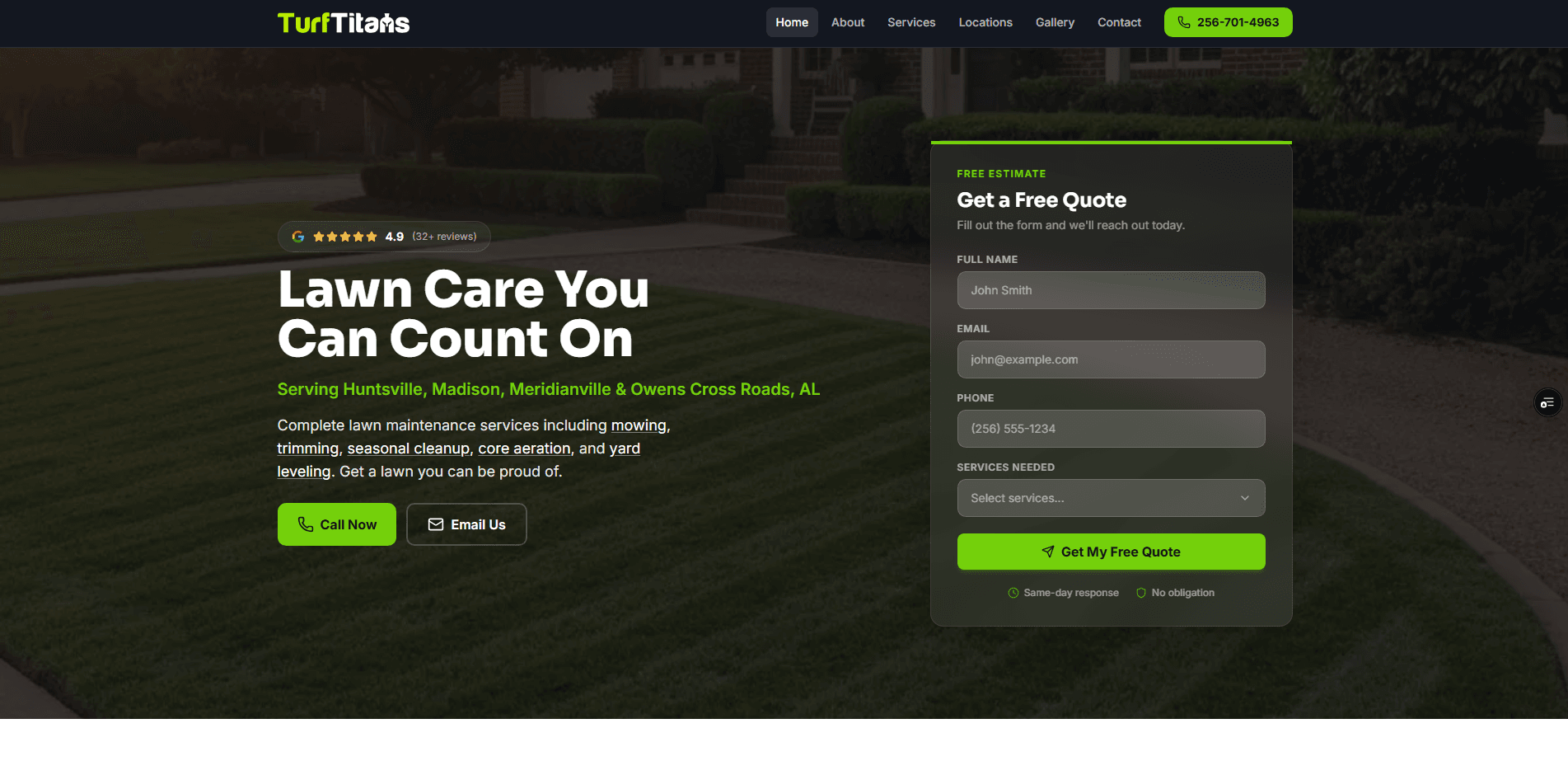
After — Launch
01 — The Challenge: Invisible in a Competitive Local Market
Great work on the ground. Zero visibility online.
Company snapshot: a lean, two-person crew
Turf Titans Lawncare started this engagement as a working team of two, including ownership, covering Huntsville and Madison, AL. That size matters context for every number on this page: this isn’t a national franchise chasing millions of impressions. Seventeen clicks on “lawn leveling service” or a Google Business Profile query list where most entries are still under 15 monthly searches aren’t small by accident — for a two-person crew, that volume of high-intent local searches is the difference between a slow week and a full schedule, not a rounding error to be embarrassed about. We report the real numbers here specifically because they’re a realistic target for a lean operator to aim for, not an inflated result only a large team could replicate. One of the two answers calls directly while out working jobs — and as demand grew past what two people could comfortably absorb, that growth is exactly what justified hiring a third (more on that in Section 3).
Before March 2026, Turf Titans had everything a lawn care and landscaping company needs to succeed in the field: a reputation for quality work, a growing crew, and a client base that kept referring neighbors. What it didn’t have was a website or search presence that reflected any of that. The old site — live since February 2024, a single page covering every service on one URL — ran on outdated HTML, loaded slowly on mobile, and carried no structured data telling Google what the business did or where it served. Organic visibility was essentially at zero — a handful of impressions scattered across the one vague, unranked page.
Huntsville and Madison, Alabama are not easy markets to win in. Both cities sit inside one of the fastest-growing metro areas in the Southeast — driven by aerospace, defense, and tech employment that has pulled in a wave of new homeowners over the past several years — and the lawn care and landscaping category has grown just as fast to serve them. The category is dense with established competitors bidding on the same “near me” and service-specific searches: lawn aeration, dethatching, top dressing, sod installation, and full landscape installation all carry meaningful monthly search volume and real commercial intent. Ranking on the first page for any single one of those terms typically takes months of consistent work, let alone all of them at once from a standing start.
Much of that competition also runs on national franchise brands with decade-old domains and thousands of backlinks — the kind of authority a local operator can’t out-publish overnight. That reality shaped the entire strategy: instead of trying to outrank national brands on broad head terms like “lawn care,” the plan targeted the specific, lower-competition, higher-intent long-tail queries those bigger competitors were too generic to own — city-modified, service-specific searches from homeowners who already knew exactly what they needed done.
At the time of the relaunch, Turf Titans was still a lawn-care-only operation — but customers were already asking about sod, hardscaping, and full landscape work the old single-page site had no way to capture or even describe. Rather than wait for a formal expansion that hadn’t happened yet, the new site was built to include a landscaping content cluster from day one, targeting that demand speculatively. That bet mattered more than expected: as covered in Section 3, the traffic and calls that followed are a direct reason Turf Titans went on to formally expand into landscaping and add a third crew member.
None of this is unique to Turf Titans. It’s the default starting position for the large majority of local home-services businesses: real skill in the field, an outdated or nonexistent digital presence, and a growing list of services that the website has never been asked to describe properly. That gap between operational quality and digital visibility is exactly what this engagement was built to close.
Key pain points at the start of the engagement:
- Near-zero branded search volume — customers couldn’t find the business even by name
- Long-tail service queries (leveling, top dressing, aeration) not ranking at all
- A slow, non-mobile-first site actively hurting conversion and Core Web Vitals
- No content clusters connecting core services to the local searches customers were actually typing
- No schema markup, so Google had no structured signal of what the business offered or where
None of these problems are unusual, and none of them require a large budget to fix — they require a deliberate sequence. The next section breaks down exactly what changed, in what order, and why that order mattered.
02 — Our Approach: New Website + Strategic Local SEO
Rebuild the foundation. Layer in strategy. Let it compound.
The engagement launched in March 2026 with a full site rebuild, followed by parallel tracks in content, technical SEO, and Google Business Profile optimization through April and May. Nothing here was a single silver bullet — it was five ordinary moves executed in the right sequence.
2.1 — Technical Foundation & Site Overhaul
Every SEO tactic downstream of this section depends on the technical foundation being right, so that’s where the engagement started. The old site was rebuilt from scratch rather than patched, because patching a site with no schema, no mobile optimization, and no logical information architecture almost always costs more in the long run than a clean rebuild.
- Complete rebuild for speed and Core Web Vitals, built mobile-first from the first wireframe — most local searches in this category happen on a phone, standing in a yard
- Proper schema markup —
LocalBusinessandService— so Google could understand and surface the business correctly in both organic results and AI-generated overviews - Clean, logical URL structure separating lawn care and landscaping service lines, so each cluster could build its own topical authority instead of competing with itself
- On-page optimization (title tags, meta descriptions, header hierarchy) built around the exact queries the site would go on to rank for — not written generically and optimized after the fact
- Fast page load times and clean markup, which matter twice over: once for user experience and conversion, and again because Core Web Vitals are a confirmed Google ranking factor
2.2 — Keyword Strategy & Content Clusters
Rather than chasing generic head terms, the strategy targeted the high-intent local + service queries customers actually type when they’re ready to hire — the kind that show up further down in the data below: lawn leveling service, yard leveling service near me, lawn care Huntsville AL, lawn top dressing service near me, and branded variations of the company name itself.
Those queries were organized into three content clusters — two matching services Turf Titans was already running, and one (full landscaping) built ahead of the business to capture demand they were fielding informally but couldn’t yet service at scale:
| Cluster | Core Pages | Example Queries Targeted |
|---|---|---|
| Lawn renovation | Leveling, top dressing, aeration, dethatching | lawn leveling service, yard leveling near me, top dressing lawn near me |
| Ongoing maintenance | Mowing, treatment, fertilization | lawn care Huntsville AL, lawn treatment, lawn mowing service |
| Full landscaping | Sod, hydroseeding, hardscaping | sod installation Huntsville AL, hydroseeding Huntsville AL |
Each cluster hub links out to its supporting pages and back to the homepage and the other clusters where the services naturally overlap — for example, a lawn renovation page linking to the maintenance plan that keeps a newly leveled lawn healthy. That cross-linking is what let three relatively small clusters start acting like a much larger, more authoritative site in Google’s eyes within a single quarter.
This cluster model matters because Google increasingly rewards topical depth over isolated keyword-stuffed pages. A single page trying to rank for “lawn care,” “lawn leveling,” and “sod installation” all at once tends to rank for none of them well. Three focused hubs, each with its own supporting content and internal links, gave Google a much clearer signal of exactly what the business does and where it’s qualified to rank.
Google Business Profile optimization ran in parallel with this content work, not after it — and it mattered enormously for trust and Map Pack visibility, feeding into the phone-call surge covered in Section 3 alongside the website itself. That work included category selection matching every core service, weekly photo uploads from completed jobs, a steady cadence of Google posts tied to the seasonal content calendar, and a review-generation process to keep star rating and review count climbing alongside rankings.
Local citation cleanup ran alongside that GBP work: a full NAP (name, address, phone) consistency fix across roughly 34 directories, plus setting up and claiming listings on Bing Places and Apple Maps — both of which were previously blank. Neither of those platforms is covered by our current call-tracking setup, which means some real inbound calls are landing on citations we can’t yet attribute to this campaign. That’s an acknowledged attribution gap, not a hidden one, and it’s one we’re actively working to close by extending tracked numbers to those listings.
2.3 — Content & On-Page Execution
Keyword strategy only matters if the pages behind it are actually good enough to rank and convert. Every service page went through the same process: understand the specific problem a homeowner is trying to solve, write to that problem directly, and make the next step (call, text, or form) impossible to miss.
- Service pages rewritten around real customer pain points (patchy lawns, standing water, bare spots), tangible benefits, and clear calls-to-action rather than generic service descriptions
- Educational blog content supporting each cluster — when to aerate in Alabama, how top dressing fixes low spots, what to expect from a sod install — written to answer the exact questions customers were typing into Google before they were ready to hire
- Internal linking built deliberately to spread authority from high-traffic pages to newer, unranked service pages and guide visitors toward a call or form submission instead of a dead end
- Consistent NAP (name, address, phone) and service-area messaging across every page, reinforcing the same signals Google was already picking up from the Business Profile
2.4 — Timeline
- March New site launch + core technical and on-page optimizations
- Apr–May Content publishing, technical refinements, Google Business Profile enhancements
- Jun–Jul Ongoing monitoring in Search Console and Analytics, iterating on what moves the needle
Common mistakes this approach avoided:
Most local businesses that struggle with SEO make one of three mistakes: they launch a new site and treat SEO as an afterthought bolted on months later; they chase broad, high-competition head terms instead of the specific long-tail searches that actually convert; or they optimize the website while ignoring the Google Business Profile, missing the channel that drives the majority of calls for local service categories. This engagement deliberately avoided all three — the technical foundation, content strategy, and Business Profile work started in the same month and ran on parallel tracks from day one.
03 — The Results: Dramatic, Measurable Growth
The numbers, straight from Search Console and the phones.
A note on methodology: monthly revenue figures come from the client’s own billing records, not a traffic or analytics estimate, and currently cover March–May only — June and July are pending from the client and will be added once available. Keyword-level clicks, impressions, and average position come directly from Google Search Console’s built-in six-month comparison, exported without edits. Call volume is imperfectly tracked — Google Business Profile call analytics and website click-to-call tracking via Vercel Analytics, which started partway through the engagement rather than from launch, both undercount — so the 40–60 calls/month figure used throughout this page is the client’s own direct confirmation, which they describe as a conservative floor rather than an exact count. The ~475 total-calls estimate is a separate, self-reported figure covering April 1 through July 4 specifically (not the full period since launch), based on the client’s own daily call count, and is called out as an estimate everywhere it appears. Form-submission totals come from the site’s internal form-collection log, tracked from launch day forward; the old single-page site’s historical form data was also pulled and manually reviewed to exclude spam and internal test entries, and is reported in 3.1 only as an aggregate count — not as published records — because the underlying submissions contain real customers’ personal information. Because the prior-period columns in Search Console are genuinely zero across almost every query — the old site simply wasn’t indexed for these terms — the keyword growth shown here isn’t normalized or adjusted; it’s the literal before-and-after.
3.1 — Revenue & Leads
Monthly revenue climbed from roughly $11,000 in March to $21,000 in April to $30,000 in May — a 2.73x increase (+173%) in two months. June and July figures are still pending from the client’s own bookkeeping and will be added once available — we’d rather show a shorter, verified revenue window than pad it with an estimate.
That lag is worth calling out explicitly, because it’s the part most case studies skip. Search visibility moved first, in March and April, as the new site and its schema markup got crawled and indexed. Calls — and the revenue behind them — didn’t follow in lockstep until the Google Business Profile work matured in May and June — reviews accumulated, photos aged into the algorithm, and the Map Pack presence solidified. For any home-services business reading this, the practical takeaway is to expect organic visibility to lead, with calls and revenue compounding a few weeks behind it once local signals catch up.
Website form submissions tell the same story from a third angle — and this is the one metric where we actually have real before-and-after data rather than just a zero baseline. The old single-page site was live for almost two years (February 2024 through the February 2026 relaunch), and its form history is still on file. After excluding obvious spam and bot submissions (garbled names, junk emails) and a couple of internal test entries, the old site generated roughly 45 real customer inquiries over ~23 months — under 2 per month. The new site went live on February 19, 2026, and the first tracked form submission came in just six days later, on February 25. Internal form-tracking now shows 143 form submissions to date in 4 months — a rate of roughly 32 per month, about 16x the old site’s pace, and still climbing well past the original 90-day mark covered in the launch case study below.
Worth noting: Turf Titans wasn’t doing zero marketing before this campaign. They were distributing roughly 300 door hangers a month — a real, ongoing offline effort, not a business sitting still — and it was producing well under 10 calls a month. That door-hanger effort stopped once the new site launched, so the call volume that followed is the digital campaign’s own result, not just “any marketing beats none.”
Call volume is worth a note on methodology of its own, because the tracked and reported numbers don’t agree with each other. In the most recent tracked month, Google Business Profile call analytics show just 15 calls — a number low enough that the client flagged it unprompted as not matching their own experience. Rather than rely on GBP’s count alone or on website click-to-call tracking (via Vercel Analytics), which only started partway through the engagement and doesn’t capture the full picture either, we asked the client directly. They confirm actual call volume is running 40–60 calls per month — and they’re clear that even that range is a conservative, low-end estimate on their part, not a ceiling. Separately, the client’s own daily count — which we can’t independently verify, but which they’ve confirmed consistently — has run at least 5 calls a day since April. Over the roughly 95 days from April 1 through July 4, that works out to an estimated ~475 calls in that window alone. Part of the gap is a known, unresolved tracking hole: citation cleanup set up new listings on Bing Places and Apple Maps (see 2.2), and calls originating from either of those aren’t captured by GBP or website analytics at all yet — an attribution gap we’re actively working to close, not one we’re pretending doesn’t exist. We’re showing all of these numbers, including the tracked figure that clearly undercounts, rather than quietly picking the one that looks best.
$11K → $30K
Monthly revenue, Mar → May (Jun/Jul pending)
40–60
Calls per month, client-confirmed (low-end estimate)
~475
Estimated calls, Apr 1 – Jul 4 (self-reported, ~5/day)
2.73x
Revenue growth, Mar → May (+173%)
143
Tracked form submissions to date
3.2 — Google Search Console: Last 6 Months vs. Prior 6 Months
Every query below shows the same pattern: zero clicks and zero impressions in the prior six-month window, because the old site had no functional search presence. Across the full query set, 74 distinct search terms went from 0 to generating real clicks, totaling 271 clicks and 7,092 impressions in the trailing six months — and that’s before counting the hundreds of additional impression-only queries building toward their own breakout.
One quick definition for readers less familiar with Search Console: average position is Google’s estimate of where a page typically ranks for a given query across all the times it appeared in search results, where 1.0 is the very top organic result. A position of 5.4, like “turf titans” below, means the page is landing in the top half of page one on average — not just occasionally spiking there. Lower is better, and anything under roughly 10 is generally considered page-one visibility.
Branded queries
| Query | Clicks | Impressions | Avg. Position |
|---|---|---|---|
| turf titans | 69 | 502 | 5.4 |
| turf titans lawn care | 36 | 154 | 3 |
| turf titans lawncare | 14 | 212 | 9.7 |
| turf titans landscaping | 10 | 65 | 10.2 |
| titan turf management | 8 | 38 | 9.8 |
| turf titan lawn care | 4 | 93 | 10.3 |
| titan turf | 3 | 42 | 10 |
| lawn titans | 3 | 20 | 24 |
Top 20 non-branded service queries (from 0 clicks/impressions previously)
| Query | Clicks | Impressions | Avg. Position |
|---|---|---|---|
| lawn leveling service | 17 | 105 | 9.1 |
| yard leveling service | 10 | 72 | 3.9 |
| lawn care huntsville al | 7 | 914 | 13.5 |
| lawn leveling near me | 7 | 185 | 57.9 |
| lawn leveling service near me | 5 | 51 | 19.3 |
| yard leveling near me | 4 | 41 | 28.4 |
| lawn top dressing service near me | 4 | 31 | 38.9 |
| top dressing lawn near me | 3 | 13 | 5.5 |
| lawn care near me | 2 | 805 | 4.7 |
| lawn services huntsville al | 2 | 508 | 17.7 |
| huntsville al lawn care | 2 | 69 | 16.6 |
| lawn care huntsville alabama | 2 | 46 | 6.8 |
| yard clean up near me | 2 | 40 | 8.3 |
| lawn leveling services near me | 2 | 25 | 11.5 |
| lawn aeration service near me | 2 | 18 | 7.1 |
| lawn care services | 1 | 753 | 1.2 |
| lawn treatment | 1 | 708 | 2 |
| lawn care services huntsville al | 1 | 278 | 12.1 |
| lawn mowing service huntsville al | 1 | 183 | 11 |
| sod installation huntsville al | 1 | 68 | 33.2 |
Key wins to highlight:
- “turf titans” — 69 clicks (from 0), 502 impressions, average position 5.4
- “turf titans lawn care” — 36 clicks, average position 3.0
- Strong long-tail service terms now ranking: lawn leveling service, yard leveling near me, and multiple top dressing variants
- Many terms went from 0 impressions and 0 clicks to hundreds or thousands of impressions
- 44 of the 74 clicked queries now carry an average position inside the top 10
3.3 — Monthly Trend: Clicks & Impressions
The daily Search Console data (Feb 12 – Jul 2, 2026) shows a clear ramp-up beginning in mid-March — the week of launch — and sustained growth through June, tracking with the peak spring/summer lawn care season in North Alabama.
Tracked-Keyword Set — Monthly Clicks & Impressions (GSC)
3.4 — Additional Proof
Beyond the headline click and impression numbers, a handful of secondary metrics tell the same story from a different angle — and matter just as much for judging whether growth is real or a statistical blip.
- Top pages driving clicks: the rebuilt homepage, lawn leveling service page, and lawn care landing page account for the majority of new organic clicks — evidence that the content cluster strategy is directing search traffic to the pages built to convert it, not just to the blog
- Ranking movement: money keywords like “yard leveling service” (3.9), “lawn care services” (1.2), and “lawn treatment” (2.0) moved from unranked to top-3 average position — the exact terms most likely to convert a searcher into a call
- Breadth of coverage: impressions are now showing on well over 100 distinct queries the old site never touched, spanning both the lawn care and landscaping service lines, which reduces dependence on any single keyword or seasonal spike
The strongest proof isn’t a marketing metric
Because of the demand this campaign generated, Turf Titans formally expanded into full landscaping services and hired a third crew member — growth the client has said directly would not have been possible without this work. A hiring decision and a new service line are real operating commitments, not something a business makes on the strength of vanity traffic.
“We went from maybe one call a week to fielding calls almost every day. The phone ringing from people who found us on Google — not because we sent them there — has been the biggest change to how we plan our crews.”
3.5 — Google Business Profile Performance
Organic search isn’t the only channel doing work here. Turf Titans’ Google Business Profile logged 2,134 total profile views, and the device breakdown shows exactly where those views come from — a clear majority on mobile, and a meaningful share still coming through desktop search, which matters for how the site itself needs to perform on both.
54%
Google Search — mobile
1,142 views
37%
Google Search — desktop
798 views
5%
Google Maps — desktop
114 views
4%
Google Maps — mobile
80 views
The Business Profile’s own monthly figures tell the same launch-to-growth story as the Search Console data above, on a smaller scale specific to Google Maps and the knowledge-panel side of search:
GBP monthly search impressions & website clicks
Top search queries used to find the profile
Google only reports exact counts above its own reporting threshold; every query listed as “< 15” is a real, attributed search that found this profile, just below the count Google discloses precisely. We’re showing the full list rather than only the top few branded terms.
3.6 — Do These Numbers Actually Line Up?
It’s a fair question: does anything on this page actually prove the Search Console clicks are real, rather than noise or misattribution? Search Console and Google Business Profile both measure the same side of the funnel — what happens on Google’s side, before a visitor ever reaches the site. Website form submissions measure the opposite end: real behavior on the site itself, tracked entirely independently through Turf Titans’ own form-collection log, with no shared infrastructure or reporting logic connecting it to Google’s numbers at all.
That independence is what makes the timing worth pointing out. The site launched February 19, GSC impressions and clicks began climbing the same week, and the first website form submission arrived just six days later, on February 25 — followed by a steady, uninterrupted climb to 143 submissions by early July. If the reported search growth were inflated or bot-driven noise, there would be no reason for a separate, independently-tracked count of real people filling out a real form to rise in the same window and keep climbing every month since. It isn’t mathematical proof that any single click number is exactly correct — no outside system can verify Google’s own count down to the click. But a steadily growing, independently-tracked conversion metric that starts the same week search visibility starts, and keeps growing every month after, is exactly the kind of corroborating signal you’d expect to see if the underlying traffic is real — and exactly the kind that wouldn’t show up if it weren’t.
3.7 — How This Compares to a Typical Local SEO Timeline
For context, most local SEO engagements don’t show meaningful ranking movement until month four to six, and it’s common for agencies to set that expectation up front to manage impatience. Turf Titans saw its first ranking movement inside three to four weeks of launch and a visible call-volume increase by the second month. That speed wasn’t magic — it came from starting with a site that had effectively zero existing SEO debt to undo, which meant every optimization was new signal rather than a correction to years of accumulated technical issues. Businesses starting from an older, more established site with existing rankings to protect should expect a somewhat longer runway, since some of that work involves untangling legacy problems before new gains can show through.
Want results like these?
Your business could be next.
04 — What We Learned + The Repeatable Playbook
The Local Lawn Care & Landscaping SEO Playbook
Strip away the specifics and this case study is really a seven-step framework any local home-services business can run. Nothing here is proprietary — it’s disciplined execution of fundamentals most competitors skip.
This framework is written for owners and marketers of local, service-based businesses — lawn care, landscaping, HVAC, plumbing, roofing, cleaning, pest control — who have a functioning business with real reviews and real jobs to show, but a digital presence that hasn’t caught up. If that description fits, the seven steps below are the same sequence, in the same order, that produced the results in Section 3.
- 1
Start with a fast, mobile-first, schema-rich website.
Speed and structured data (LocalBusiness + Service schema) are the floor, not a bonus. If Google and mobile users can't parse the site quickly, nothing downstream in this list will work as well as it should.
- 2
Identify high-intent local service keywords.
Use Search Console, competitor research, and 'near me' + service + city variations — not just head terms. The searches that convert are almost always more specific than what most owners assume people type.
- 3
Build content clusters around core services.
Group leveling, aeration, top dressing, sod, and full landscaping into their own hubs with internal links, so each cluster builds topical authority instead of competing against itself for the same rankings.
- 4
Optimize Google Business Profile aggressively, in parallel.
This is what drives the majority of immediate phone calls — don't wait until the site is 'done.' Categories, photos, posts, and reviews should start moving the same week the site launches.
- 5
Publish regular educational and service content.
Answer the seasonal questions customers are already searching — when to aerate, how to fix bare spots, what a sod install actually costs. This content earns trust before the sales conversation even starts.
- 6
Track weekly in GSC and Analytics; iterate on what moves the needle.
Double down on the clusters gaining impressions and clicks; rework or consolidate the pages that aren't moving after 60–90 days rather than leaving them untouched indefinitely.
- 7
Focus on conversion, not just traffic.
Clear CTAs, trust signals, and fast lead forms turn visibility into a ringing phone. Traffic without a conversion path is a vanity metric, not a business result.
Seasonal Tips for North Alabama Lawn Care
One detail that’s easy to miss in a national SEO framework: search intent for lawn care is sharply seasonal, and the content calendar has to lead the season by several weeks, not follow it. Publishing an aeration guide the week homeowners start searching for it is too late — that content needs to already be indexed and ranking by the time demand spikes.
- Spring (Mar–May): lead content and ads with leveling, top dressing, and aeration — the highest-intent searches of the year
- Early Summer (Jun): capture peak-season maintenance and mowing searches; this is when call volume compounds fastest
- Fall (Sep–Oct): shift content toward aeration and overseeding — Bermuda and Zoysia lawns in North Alabama need a different seasonal message than cool-season markets
- Winter (Dec–Feb): use the slow season to publish next year’s content clusters and refresh Google Business Profile photos before the spring surge
Free download
2026 Local Lawn Care & Landscaping SEO Checklist + Keyword List
The exact framework above, turned into a step-by-step checklist — plus the full keyword list we used to map content clusters for Turf Titans. Enter your info and we’ll email it to you.
05 — Why This Matters for Other Home Service Companies
Local SEO still works in 2026 — when it’s built on real data.
It’s easy to read a results-heavy case study like this one and assume the takeaway is specific to lawn care, or to Alabama, or to this particular agency. It isn’t. The underlying lesson generalizes to any local, service-based business competing for customers who search before they call — HVAC, plumbing, roofing, pest control, cleaning, and landscaping all run on the same fundamentals. Five things stood out as broadly applicable, regardless of category:
Local SEO still works extremely well in 2026, when it's executed with real keyword data and a technically sound new site — not templated pages and hope. There is no shortage of local businesses running last decade's SEO tactics on a site that was never built to support them; fixing the foundation first is still the highest-leverage move available.
Branded search grows naturally as visibility improves. Turf Titans didn't run a branding campaign; 69 monthly 'turf titans' clicks are the byproduct of showing up everywhere else — in the Map Pack, in service-specific organic results, and in customers' day-to-day experience with trucks and yard signs. Branded search volume is a lagging confirmation that a strategy is working, not a starting point.
Phone calls, not just traffic, are the metric that matters for service businesses. A traffic chart means nothing to an owner scheduling crews and buying materials for next week's jobs. Calls do. Any agency reporting on a local services campaign should be reporting call volume and lead quality alongside sessions and rankings, not instead of them.
Fast wins are possible in under 90 days with the right foundation. This isn't a 12-month wait-and-see strategy — the ramp started inside the first month and compounded through the peak spring season. Speed matters most for seasonal businesses, where missing the first 90 days of the season can mean missing the year.
AI-powered search favors structured, data-backed content. Google AI Overviews, Perplexity, and ChatGPT all pull from clearly structured, schema-rich, authoritative pages — which is exactly why this case study leans on real tables, real numbers, and clear headings rather than vague claims. The businesses that document their results this specifically are the ones AI search tools will keep citing.
06 — Frequently Asked Questions
Common questions about this campaign
How long does local SEO take to show results for a lawn care or landscaping company?
In this case, measurable organic growth began within 3–4 weeks of launch, with call volume climbing inside the first 60 days. Most home-service businesses should expect a 60–120 day runway before rankings and calls compound — faster if the old site had near-zero technical foundation to begin with, as Turf Titans did.
What mattered more: the new website or the Google Business Profile?
Both, but Google Business Profile's own analytics undersell its role here. GBP call tracking showed just 15 calls in the most recent month — a number low enough that the client flagged it unprompted as not matching reality. When we asked directly, the client confirmed actual volume runs 40–60 calls per month, and called that range conservative, not a ceiling. The website built the technical and content foundation that let 100+ long-tail queries rank at all; GBP mattered enormously for trust and Map Pack visibility. Neither platform's own tracking captures the full call volume on its own — the client's direct confirmation is the more reliable number here.
Do branded searches like 'turf titans' actually matter for SEO?
Yes. Branded query volume is a trailing indicator of real-world brand awareness — people who saw a truck, a yard sign, or a referral and searched the company name directly. Turf Titans went from 0 branded clicks to 69 in six months, which is a signal that off-site visibility (trucks, GBP, reviews) and on-site SEO were reinforcing each other.
Can this framework work outside of lawn care and landscaping?
The framework is category-agnostic. Any local home-services business — HVAC, roofing, pest control, cleaning — can run the same five steps: fast mobile-first site with schema, high-intent keyword mapping, service-based content clusters, aggressive GBP optimization, and weekly iteration on GSC data. The keyword list changes; the method doesn't.
How many keywords does a lawn care company actually need to rank for?
Fewer than most owners assume to start, but more than most agencies build for. Turf Titans now generates impressions on 300+ distinct queries and clicks on 74 of them from a standing start — driven by roughly a dozen core service pages, each covering the 'near me,' city-modified, and problem-based variations of one service.
Why publish the full Search Console data instead of just the highlight numbers?
Because a highlight reel is easy to dismiss and hard to learn from. Showing the full branded and non-branded query tables — including modest, single-digit-click terms — gives other business owners and marketers a realistic picture of what a 90-day ramp actually looks like: a small number of breakout terms alongside a much longer tail of smaller wins that add up.
What would you change or do differently next time?
The biggest lesson was sequencing the Google Business Profile work even earlier relative to the site launch — the call-volume lag in April would likely have been shorter if photo and review momentum had started building a few weeks before the new site went live rather than alongside it.
Ready to 3X your own local leads?
Get your free
SEO audit.
Turf Titans went from invisible to 100+ ranking keywords and 40–60 calls a month in 90 days. Tell us about your lawn care, landscaping, or home-services business and we’ll walk through exactly what’s possible for you.
Read the original 90-day launch case study →See all case studies →Base64 Marketing & AI Consulting builds websites, local SEO, and lead-capture automation for Chicago-area and nationwide home-services businesses. This playbook is the same process we run for every client — documented in full so you can evaluate it before you ever get on a call with us.
Updated July 2026 · Data source: Google Search Console, Feb 12 – Jul 2, 2026, and internal call tracking.